
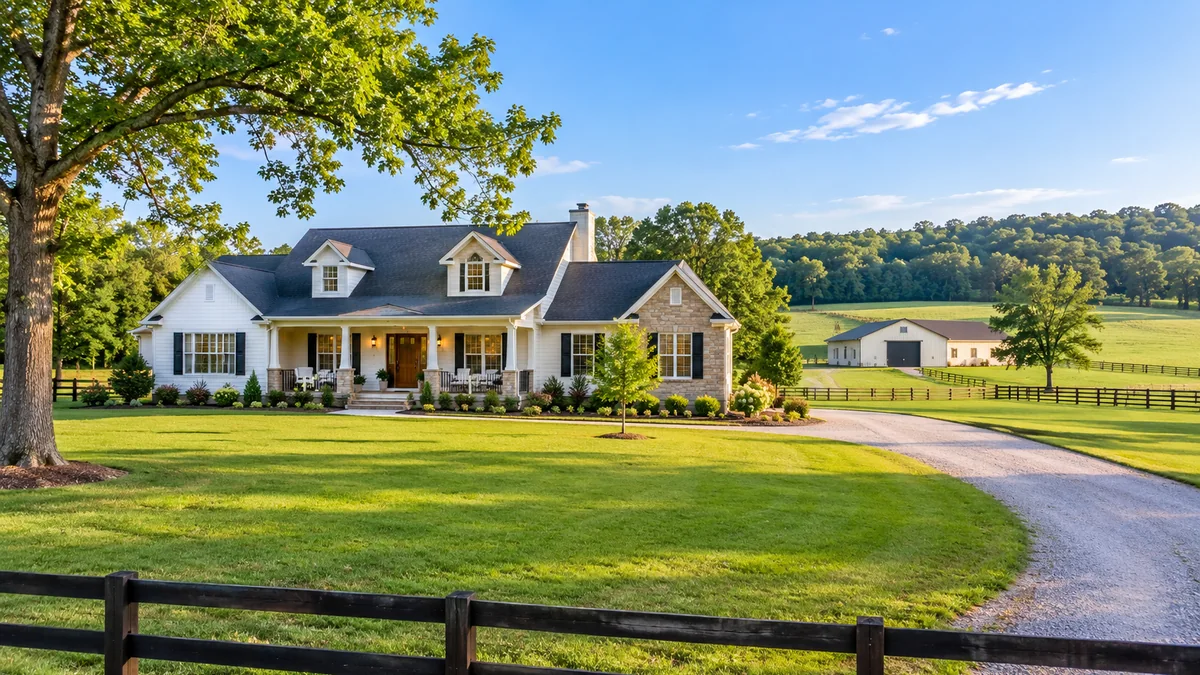
Looking for homes with acreage for sale in the USA? A property with a house and several acres can offer privacy, room for gardens or animals, space for a workshop, and a quieter rural setting. But acreage alone does not tell you whether a property is a good fit. Buyers should compare the home, usable land, access, water, septic or sewer, zoning, outbuildings, insurance and ongoing maintenance before making an offer.
This guide focuses on residential homes with land—from a country house on a few acres to a larger rural home or estate. It is not a directory of working farms or vacant land. Listing inventory, prices and property details change, so verify every home with the listing contact and public records.
Where to find homes with acreage for sale
Search more than one real-estate marketplace. Listing sites classify rural properties differently, and filters may use “lot size,” “acreage,” “land,” “farm,” “ranch” or “country home.” Compare the listing details and confirm whether an existing house is included.
- LandSearch – houses with land in the United States: browse homes with land and narrow by state, acreage, price and property features.
- Land.com – land and rural property listings: explore homesites, farms, ranches, recreational land and larger rural properties.
- LandWatch – farms and ranches: compare rural listings and use parcel-size and property-type filters.
- Land & Farm – land and country property listings: review land listings that may include homes, barns, workshops and other improvements.
- Zillow and Realtor.com: search a chosen city or ZIP code, then review lot size and property details.
Useful searches include “homes with acreage for sale,” “houses for sale with acreage,” “homes for sale with land,” “rural homes for sale” and “country homes with acreage.” Add a state, county or ZIP code to narrow the search. A listing site’s filter is a discovery tool, not proof of acreage, boundary or legal use.
What type of acreage home are you looking for?
Country homes and rural houses
A country home may sit on open pasture, wooded land or a mixed-use parcel. Some properties are ordinary residential houses with extra outdoor space; others include barns, workshops, sheds, gardens or small livestock facilities. Check which structures are included in the sale and whether they have permits where required.
Ranch-style homes and ranch properties
“Ranch home” can mean a single-story architectural style, while “ranch property” can mean a larger tract used for livestock, recreation or agriculture. Read the listing carefully so you do not confuse a ranch-style house on a few acres with a working ranch.
Homes with a barn, pond, workshop or wooded acreage
Feature-led searches can help you find homes with acreage and a barn, pond, workshop, guest house, horse facilities or wooded land. These features can add utility, but they also create maintenance and insurance considerations. Check roof condition, drainage, access, electrical service, permits and the condition of any outbuilding.
Small acreage vs. large acreage
Think about how much land you can realistically maintain. A one-, two- or five-acre property may provide a yard, garden and privacy, while a 10-, 20-, 40- or 50-acre parcel may require more equipment, fencing, driveway work and time. Larger tracts can have separate fields, timber, wetlands or steep areas that are not equally usable. Confirm the actual acreage and usable area instead of relying only on a headline number.
How to compare acreage and property prices
There is no single nationwide price for a house with acreage. Location, home condition, number of acres, road access, water, views, improvements, local demand and land use all affect value. A low asking price may reflect repairs, limited access, a difficult parcel, flood risk, missing utilities or a home that needs major work.
When comparing listings, record the asking price, house size, bedrooms, total acreage, approximate usable acreage, property taxes, outbuildings, utility type and distance to services. Compare similar properties in the same county or local market rather than dividing the price by acreage and assuming every acre has equal value.
Important checks before buying a home with land
- Verify the boundaries: Review the legal description and obtain a current survey when appropriate. Fences, tree lines and online maps do not necessarily show legal property lines.
- Check access and easements: Confirm legal road access, driveway rights, shared-road maintenance and recorded easements for utilities or neighboring parcels.
- Inspect water and septic: If the property uses a private well or septic system, arrange appropriate inspections and water testing. Confirm permits, system age, maintenance records and local requirements.
- Review zoning and permitted uses: Ask the county or local planning department about animals, additional buildings, home businesses, short-term rentals, subdivision, accessory dwelling units and future development restrictions.
- Assess drainage and natural hazards: Review flood maps, drainage patterns, erosion, wildfire exposure and any wetlands or conservation restrictions. A large parcel may contain land that cannot be built on or altered.
- Inspect the house and outbuildings: Use qualified inspectors for the home, roof, foundation, electrical, plumbing, HVAC, barns, workshops, fencing and other structures.
- Understand taxes and insurance: Check the county assessor’s records, tax classification and any agricultural-use valuation rules. Ask insurers about the house, detached structures, pools, livestock, wooded acreage and liability coverage.
- Confirm mineral, timber and water rights: In some states, these rights may be separate from surface ownership. Do not assume they transfer with the house and land.
Financing a house with acreage
Some lenders finance a home with acreage under a standard residential mortgage, but the property type, acreage, agricultural use, outbuildings, income-producing activity and appraisal can affect eligibility. Larger or predominantly agricultural parcels may require a different lender or loan structure. Ask lenders about acreage limits, property condition, access, well and septic documentation, appraisal requirements, down payment, fees and closing costs before making an offer.
Compare the annual percentage rate, total repayment and loan conditions—not just the monthly payment. Do not assume that every rural property qualifies for a particular government-backed mortgage program. Get the lender’s requirements in writing for the exact property.
Homes with acreage by state
Inventory and property characteristics vary widely by region. Texas, Tennessee, Missouri, North Carolina, Mississippi, Kentucky, Colorado, Georgia, Arkansas, Virginia, Oklahoma and Alabama all have rural and country-property markets, but the right location depends on your budget, climate, employment, services and intended land use. Use state and county filters to find current listings, then compare local taxes, zoning, insurance costs, road conditions and access to healthcare, schools and shopping.
A state name in a search phrase does not guarantee that a listing is available there today. Always confirm the property’s address, current status, acreage and asking price directly with the listing source.
Related rural property guides
If you are looking specifically for a working farm, productive cropland or a hobby-farm setup, see our guides to farms for sale in the USA, small farms and hobby farms, farmland for sale and farm houses for sale. For owner-listed agricultural properties, see farms for sale by owner. These pages cover distinct farm and agricultural intents; this guide is for buyers whose main goal is a residence with acreage.
Frequently asked questions
1. What does “homes with acreage” mean?
It usually refers to a residential property that includes a house and a larger-than-typical parcel of land. The exact acreage varies by listing and local market, so check the legal parcel details.
2. Where can I find houses for sale with acreage near me?
Search LandSearch, Land.com, Zillow or Realtor.com using your ZIP code, city or county. Try both “homes with acreage” and “houses with land,” then confirm the listing is active with the agent or seller.
3. Is a house with five acres considered a large property?
It depends on the local area and intended use. Five acres may provide substantial space in a suburban market but may be modest compared with a rural ranch. Consider usable land, terrain, access and maintenance rather than acreage alone.
4. Are homes with acreage more expensive to maintain?
They can be. Buyers may need to maintain longer driveways, fencing, drainage, wells, septic systems, barns, trees and larger grounds. Estimate equipment, labor, utilities, insurance and taxes before buying.
5. Can I keep horses or other animals on a property with acreage?
Possibly, but acreage alone does not grant permission. Check zoning, animal limits, fencing, shelter, water access, manure management and any homeowners’ association or deed restrictions with the local authority.
6. Can I build another house or guest house on my acreage?
Not automatically. Local zoning, minimum lot size, setbacks, septic capacity, access, utility availability, easements and recorded restrictions may limit additional construction. Confirm rules with the county before relying on future building potential.
7. What is the difference between a home with acreage and a farm?
A home with acreage is primarily a residence with additional land. A farm is generally marketed for agricultural use or production and may include cropland, pasture, farm buildings, water rights or operating infrastructure. The categories can overlap, but buyer priorities differ.
8. Should I get a land survey before buying?
A survey is often a sensible step when boundaries, acreage, fences, access or easements matter. Ask your title professional, lender and local surveyor what is appropriate for the property and transaction.
Final thoughts
The best homes with acreage for sale in the USA are not necessarily the ones with the most land or the lowest price. Focus on the house’s condition, usable acreage, legal access, water and septic, zoning, outbuildings, insurance and long-term maintenance. Compare similar local properties, verify every important detail and get qualified inspections before committing.